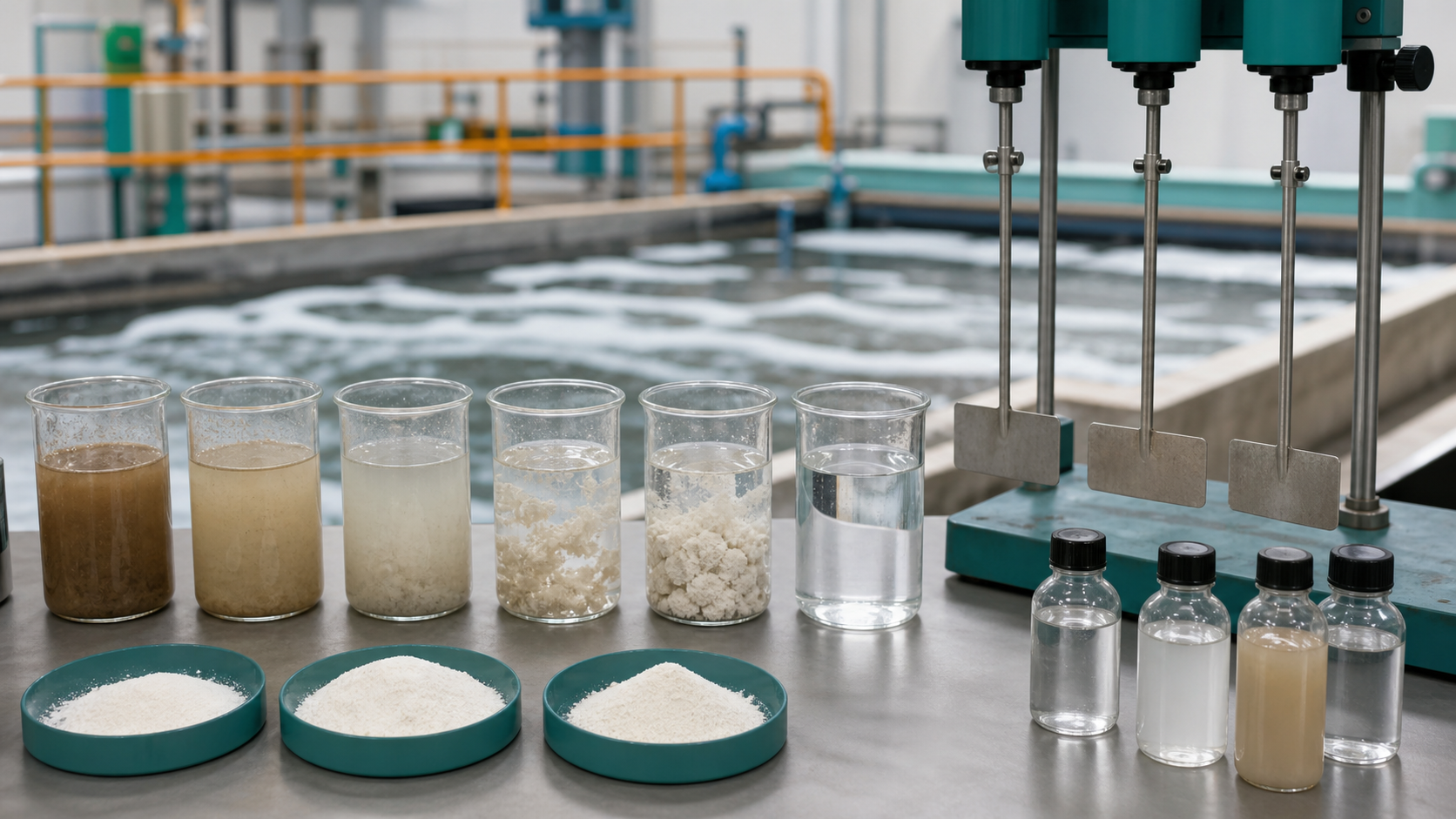
A brackish industrial wastewater flocculant tender needs more information than a single conductivity value. The source and variation of dissolved constituents, the suspended solids and the polymer preparation water all affect the comparison. Define the conditions bidders must represent instead of requesting a generic salt-tolerant product with no agreed test boundary.
Distinguish process water from preparation water
Identify the water entering the separation unit and the water used to prepare and dilute the polymer. They may have different compositions and operating histories. Record relevant measurements with units and sampling conditions, and explain changes caused by reuse, blending or production.
Do not assume that conductivity alone describes every chemical difference. Provide other available information relevant to the treatment team, without inventing a conversion from conductivity to an exact salt composition. Ask suppliers which missing data materially affect their candidate recommendation.
Agree the range used for qualification
The brackish-water selection guide provides operating context for the tender. Give Xinqi Polymer representative conditions and request an explanation of the proposed shortlist. A comparison of anionic PAM candidates should be based on the actual separation result, not an unsupported ranking by advertised molecular weight.
Identify which conditions are normal, which are occasional but expected and which fall outside the treatment plan. Evaluate meaningful changes separately where necessary. One intermediate sample may not reveal a difficult endpoint, while an isolated extreme may not represent the commercial duty being purchased.
Keep the preparation route reproducible
Specify the supplier's instructions used for each sample, including solution basis and relevant maturation conditions. Record whether laboratory preparation differs from the installed plant. If a product requires different preparation water or equipment, treat that requirement as part of the bid rather than allowing it to remain hidden behind a favourable bench result.
Assess both the separated liquid and the solids handling. Keep any reuse or downstream quality requirements independent of visual clarity, since flocculation does not establish removal of dissolved salts. Include the operating observations needed to decide whether the result is sustainable at production scale.
Award against evidence and limits
Include the preparation-water source in the bid comparison sheet, so an offer tested with laboratory water is not mistaken for one already demonstrated with the site's supply.
Record the named grade, tested range, remaining qualifications and commercial delivery basis. Require review when the actual water moves materially outside that envelope. This makes the tender comparable between bidders and prevents an ambiguous salt-tolerance claim from becoming an unconditional promise about every future brackish feed.