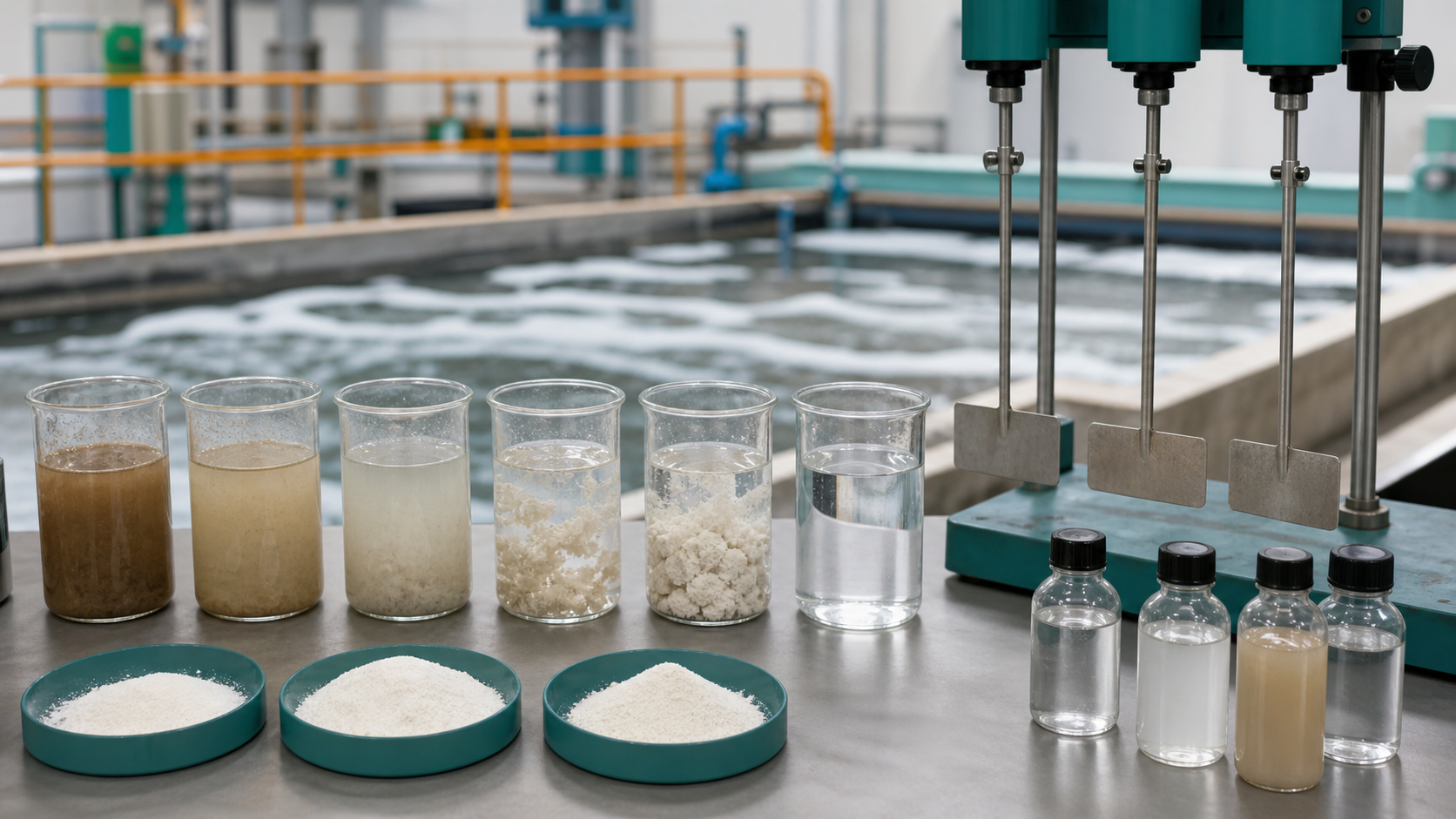
Blind flocculant trials can help procurement teams compare products without allowing a familiar brand or an expected winner to influence visual scoring. Coding samples does not make a weak experiment reliable, however. The wastewater may change during testing, preparation may differ and the first candidate may receive more careful attention than the last. Control these practical sources of bias alongside the labels.
Keep identity hidden from scoring, not from safety
An authorised coordinator should retain the identity and safety information for every coded product. People handling materials still need the information required for safe use, spill response and compatibility. The aim is to conceal commercial identity from performance scoring where practical, not to create unidentified chemicals on a laboratory bench.
Set the evaluation criteria before results are visible. Choose measurements appropriate to the process, such as settling at a stated observation time, liquid clarity, sludge volume or a defined drainage test. Record each criterion separately. A single subjective label such as excellent encourages reviewers to overlook trade-offs between attractive floc and useful separation.
Balance the order and repeat a reference
Do not always test candidate A on the freshest sample and candidate D after the wastewater has stood for hours. Plan a balanced order across repeats and include the current product at more than one point. If the reference response drifts, investigate sample ageing, temperature or preparation conditions before interpreting small differences between candidates.
When Xinqi Polymer participates, supply the same written test brief given to every polymer supplier. Request product-specific preparation guidance while keeping the performance measurements comparable. The article library covers the concentration and stock-solution controls that must support any blind comparison.
Preserve observations before discussion
Have reviewers record scores or instrument readings independently before the group discusses the jars. Label photographs with the code, dose and elapsed time rather than the suspected supplier. Retain the original worksheet even if the team later agrees on a corrected observation. This prevents the final report from becoming a reconstruction of the preferred conclusion.
Replicate meaningful differences on another representative wastewater sample. Two jars from the same mixed container test repeatability under one condition, not robustness across changing production. If performance is effectively tied within measurement uncertainty, say so. Procurement can then compare logistics, preparation burden and support without inventing a technical superiority that the trial did not show.
Unblind after the technical ranking
Record the provisional performance ranking and any limitations before revealing commercial identity. Then add price on a consistent dose basis and the actual operational requirements. A coded trial does not replace full-scale confirmation. Its value is a transparent shortlist and a record that explains why a candidate advanced, including results that did not favour the expected winner.